
A technical resource for designing watch cases around real mechanical movements.
A movement-led watch case design system, HorologyCAD helps designers build manufacturable watch case architecture around real mechanical movements, clearances, sealing systems, tolerances, and assembly constraints.
HorologyCAD explains how to design a watch case from the movement outward — using movement dimensions, internal case geometry, clearances, crown and stem alignment, sealing, manufacturing constraints, and pre-production validation.
HorologyCAD is built from real-world watch case development, practical CAD commissioning experience, and movement-led engineering documentation.
This system is designed to help you develop watch case architecture that fits, assembles, seals, and can be manufactured around real mechanical movement constraints.
Who this is for
HorologyCAD is for people who want to design watch cases properly, not guess.
It is for builders, designers, CAD users, microbrand founders, and technically minded watch enthusiasts working around real mechanical movements such as the SW200-1, Miyota 9015, Seiko NH35/NH36, ETA 2824-2, ETA 2892-A2, ETA 6497, and Sellita SW300-1.
It is for projects where internal fit, alignment, sealing, manufacturability, and production readiness matter.
Who this is not for
HorologyCAD is not for styling-only design.
It is not for watch collecting, reviews, brand commentary, or concept-only case sketches.
This is not a watch blog.
This is not styling guidance.
This is not general watch content.
HorologyCAD is a structured engineering system for designing manufacturable watch case architecture around real mechanical movements.
Why This Approach Exists
Most watch case design problems begin when the case is treated as an outside shape first.
That approach is backwards.
A functional watch case must begin with the movement.
The case is not an empty shell waiting for a movement. It is a movement housing system defined by internal mechanical constraints.
The movement defines:
- dimensions
- stem height
- hand stack
- rotor envelope
- movement location
- clearances
- alignment
- assembly behaviour
- sealing constraints
- manufacturing limits
Everything else follows.
A case may look correct externally while failing internally because the movement position, crown alignment, clearance stack, sealing geometry, or manufacturing assumptions were never resolved properly.
HorologyCAD is designed to prevent those failures before the case reaches production.
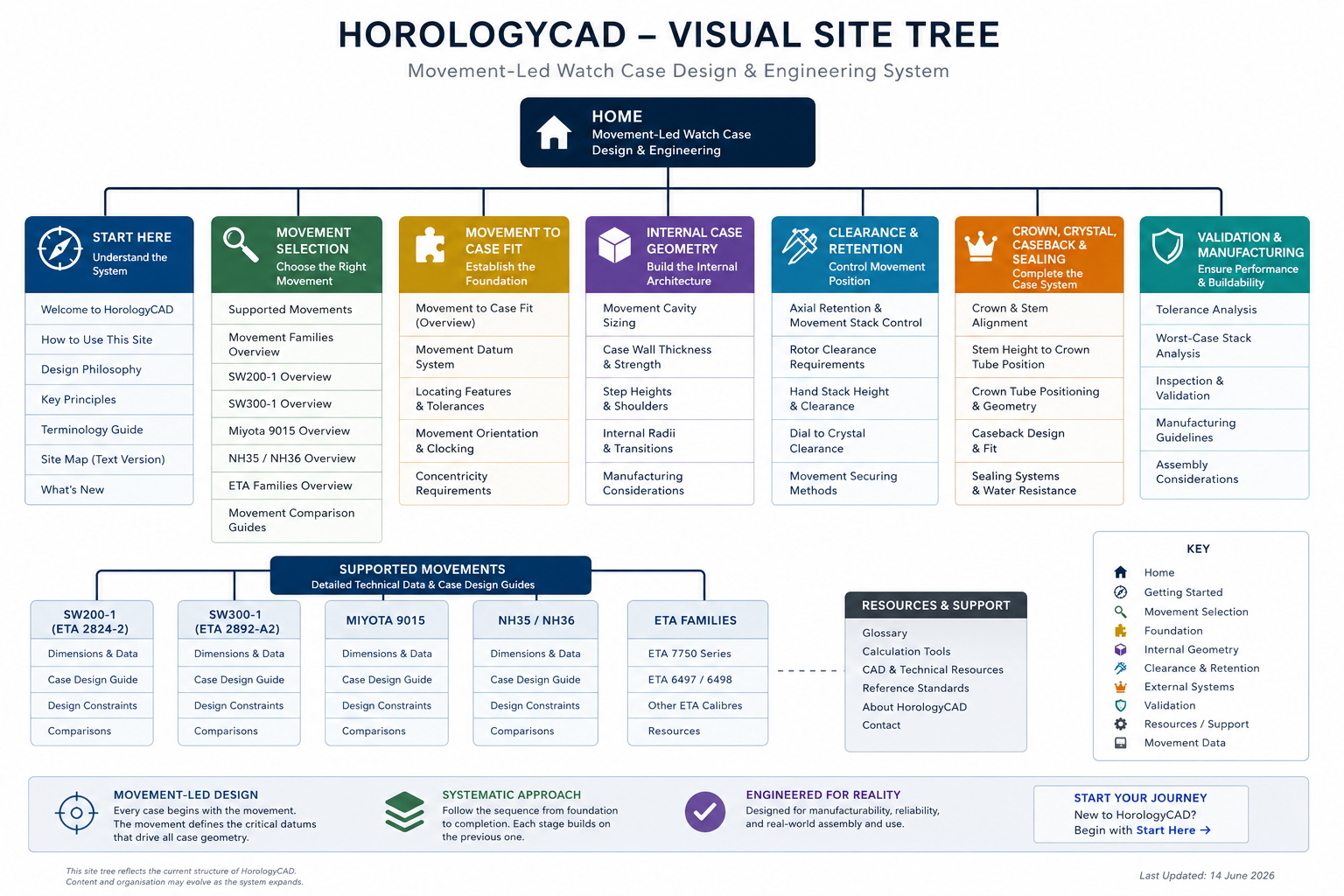
HorologyCad Engineering System Map
The site is structured from movement selection and case fit through clearance, integration, sealing, manufacturing, and final validation.
Start Here — Begin With the Movement
A usable watch case is defined from the movement outward.
Do not start with case diameter.
Do not start with appearance.
Do not start with the external case shape.
Start with the movement, then build the case architecture around the constraints it creates.
The recommended starting path is:
→ Movement Selection
→ Movement to Case Fit
→ Internal Case Geometry & Movement Cavity Sizing
→ Radial Clearance
→ Axial Clearance
→ Crown and Stem Alignment in Watch Cases
Each stage defines constraints that control the next.
Choose Your Starting Point
You do not need to read everything at once.
Start from the stage that matches your project, then follow the system forward.
Beginner — Learn the System From First Principles
Start here if you are learning how watch case design works.
This pathway explains why the movement controls the case, how movement dimensions affect the internal envelope, and why case design should begin before the outside form is finalised.
Builder — Already Designing a Case
Start here if you are working on a case design and need to resolve fit, alignment, clearance, securing, or internal geometry.
→ Movement to Case Fit
→ Internal Case Geometry & Movement Cavity Sizing
→ Crown and Stem Alignment in Watch Cases
This pathway is for practical CAD development and movement-led case architecture decisions.
Advanced — Refining for Manufacturing and Production
Start here if you are checking whether a case can be machined, assembled, sealed, and used reliably.
→ Watch Case Tolerances
→ CNC Machining Constraints in Watch Cases
→ Design Validation Checklist
This pathway focuses on tolerance control, manufacturability, sealing risk, failure modes, and production readiness.
The HorologyCAD System
Watch case design is a constraint-led engineering process.
The movement defines the internal requirements of the case. Those requirements control the case cavity, movement position, radial clearance, axial clearance, dial-side stack, crown alignment, sealing strategy, manufacturing limits, and final validation.
HorologyCAD organises those decisions into a fixed sequence.
Movement
The movement defines the case’s core dimensional and mechanical requirements.
It controls diameter, height, stem height, hand stack, rotor envelope, architecture, availability, and serviceability.
Case Fit
Case fit translates movement data into the internal case envelope.
This includes movement position, movement holder strategy, securing method, mounting system, and the relationship between the movement and the case body.
Clearances
Clearance is controlled engineering space, not emptiness.
Radial clearance, axial clearance, dial clearance, hand clearance, crystal clearance, rotor clearance, and internal movement protection must all be resolved before the case can be considered functional.
Integration
Integration connects the movement to the rest of the case architecture.
This includes crown and stem alignment, crown tube position, keyless works protection, dial seating, rehaut alignment, caseback fit, and crystal retention.
Sealing
Sealing is the result of geometry, compression, tolerance control, and surface condition.
The caseback, crystal, crown, gaskets, mating surfaces, and assembly behaviour must work together as one system.
Manufacturing
A design only matters if it can be produced consistently.
Manufacturing converts the case architecture into machinable geometry using CNC constraints, tolerance stacks, fit classes, material behaviour, wall thickness, finishing allowance, and structural rigidity.
Validation
Validation checks whether the case can actually be manufactured, assembled, sealed, and used.
It tests assembly order, tolerance behaviour, sealing risk, thin-case risk, misalignment risk, interference points, and failure modes before production.
Output
The result is a manufacturable, assembly-ready watch case architecture based on real movement constraints.
System Flow
Movement
→ Case Fit
→ Clearances
→ Integration
→ Sealing
→ Manufacturing
→ Validation
→ Output
Skipping stages creates avoidable failures.
A case may look right on the outside while failing inside because of incorrect movement location, poor crown and stem alignment, insufficient clearance, weak sealing geometry, or unrealistic manufacturing assumptions.
Engineering Areas Covered
HorologyCAD covers the complete movement-led watch case design stack.
The site is designed to be used as a sequence, not as a collection of unrelated articles.
Movement Selection and Movement Data
The movement defines the dimensional envelope that the case must accommodate.
Its diameter, height, stem position, hand stack, rotor behaviour, availability, and serviceability all affect the case architecture.
Key pages:
→ Movement Selection
→ Watch Movement Dimensions Explained
→ Supported Movements for Watch Case Design
Movement selection is not only a brand or specification decision.
It controls the entire internal case design.
Movement-Specific Case Design
HorologyCAD applies the same movement-led method across defined reference movements.
These pages connect movement dimensions to case fit, clearance, crown and stem alignment, retention, sealing, and manufacturable case architecture.
Key pages:
→ SW200-1 Case Design Guide
→ Sellita SW200-1 Dimensions & Technical Data for Watch Case Design
→ SW200-1 Case Design Constraints
The SW200-1 is treated as a primary reference movement, but HorologyCAD is not limited to one calibre.
The system supports movement-led case design across defined reference movements including the SW200-1, Sellita SW300-1, Miyota 9015, Seiko NH35/NH36, ETA 2824-2, ETA 2892-A2, and ETA 6497.
For the full movement list, use:
→ Supported Movements for Watch Case Design
Movement-to-Case Fit
Once the movement is selected, the case must be designed around its physical requirements.
Movement-to-case fit is the first translation from movement data into usable internal case geometry.
Key pages:
→ Movement to Case Fit
→ Movement Height vs Case Thickness
→ Movement Securing Methods
The case must locate, support, retain, and protect the movement without forcing it into the wrong position.
Internal Geometry and Clearances
Internal geometry determines whether the case can actually assemble, close, seal, and function.
Clearance is not empty space. It is controlled allowance for manufacturing variation, assembly behaviour, movement protection, and functional reliability.
Key pages:
→ Internal Case Geometry & Movement Cavity Sizing
→ Radial Clearance
→ Axial Clearance
These pages define the core spatial framework of the watch case.
Dial, Hand, and Display Integration
The dial-side system controls visual alignment, internal stack height, and clearance above the movement.
The visible side of the watch still depends on hidden engineering constraints.
Key pages:
→ Hand Stack Height and Clearance Requirements
→ Dial to Crystal Clearance
→ Dial Seat Geometry
Dial, hand, crystal, and rehaut decisions must be resolved as part of the internal stack, not treated as decoration.
Crown, Stem, and Keyless Works
Crown and stem geometry must align with the movement.
Incorrect crown alignment can damage the keyless works, compromise sealing, increase operating friction, and make the watch feel mechanically poor even when the case looks correct.
Key pages:
→ Crown and Stem Alignment in Watch Cases
→ Crown Tube Positioning & Geometry
→ Crown Tube Installation & Tolerances
This area connects movement stem height, case tube position, crown geometry, sealing, and functional operation.
Caseback, Crystal, and Sealing Systems
The case must close, retain its components, and seal under real assembly conditions.
Sealing is not a single gasket choice. It is the result of geometry, compression, tolerance control, surface finish, and assembly behaviour.
Key pages:
→ Watch Caseback Design and Fit
→ Crystal Sealing System
→ Water Resistance Engineering in Watch Cases
A sealed case is only valid when the caseback, crystal, crown, gaskets, and mating surfaces work together as one system.
Manufacturing, Tolerances, and Materials
A watch case design only matters if it can be manufactured consistently.
Manufacturing constraints determine whether the design remains functional after machining, finishing, assembly, and use.
Key pages:
→ Watch Case Tolerances
→ CNC Machining Constraints in Watch Cases
→ Clearance vs Interference Fits
The design must reflect achievable tolerances, tool access, finishing effects, material behaviour, wall thickness, rigidity, and fit strategy.
Assembly, Failure Analysis, and Validation
The complete case architecture must be checked before production.
Failure usually begins when one constraint is ignored and then propagates through the rest of the system.
Key pages:
→ Design Validation Checklist
→ Failure Cascade Analysis
→ Why Most Watch Case Designs Fail
Validation checks that the case can be manufactured, assembled, sealed, and used without hidden system failures.
Final Outcome
Following the HorologyCAD system helps produce a case architecture with:
- a movement-defined internal envelope
- controlled radial and axial clearances
- correct crown and stem alignment
- protected keyless works
- defined dial, hand, and crystal clearance
- functional movement securing
- controlled caseback fit
- engineered gasket compression
- manufacturable tolerance strategy
- reduced failure risk
- assembly-ready geometry
The result is not only a watch case outline.
It is a complete engineering foundation for designing a manufacturable watch case around a real mechanical movement.
Next Step
Start with the movement.